

New infrastructure. Same human conversation.
Pilvi Interpreter has moved to LiveKit, with a new logo to mark the next chapter. The previous version ran on a self-hosted virtual machine with FreeSWITCH and Pipecat. The latest version moves the voice foundation and agent hosting to managed infrastructure.
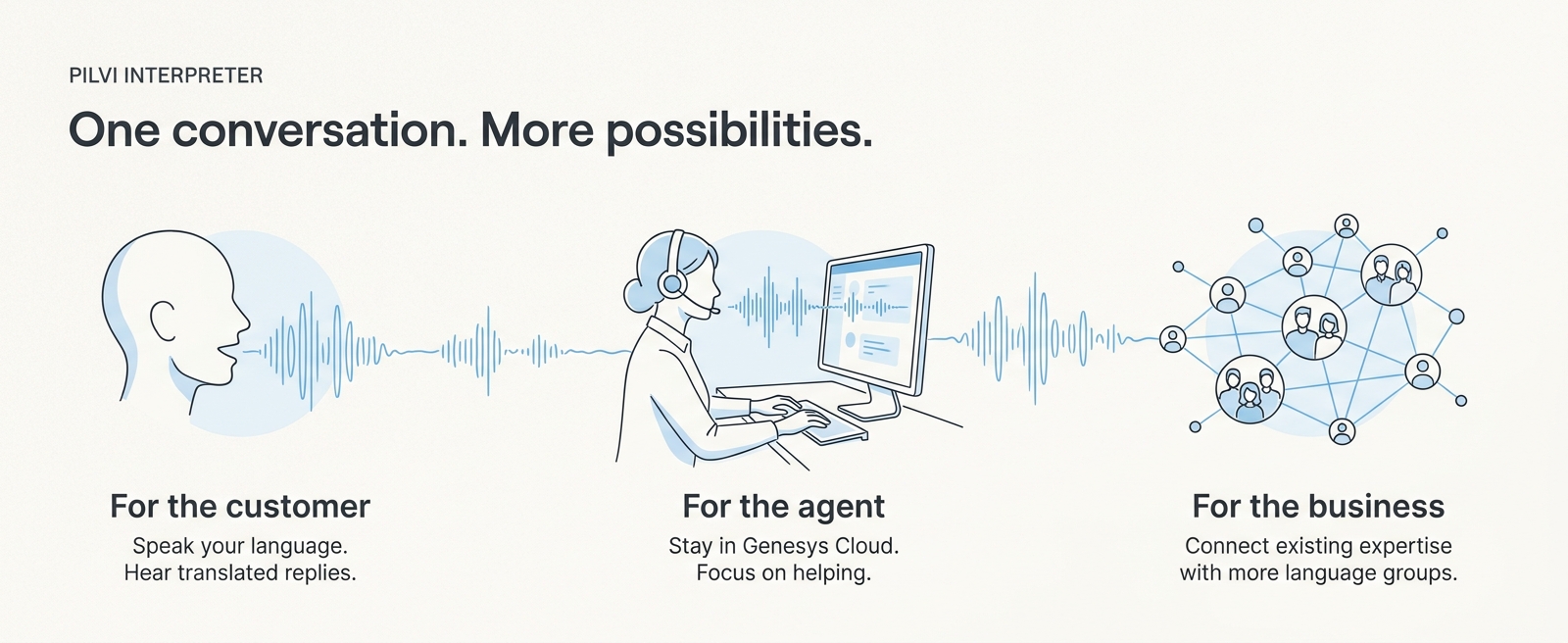
The idea stays the same: the customer speaks one language, the agent speaks another, and translation connects the two. The agent remains responsible for helping the customer. Genesys Cloud remains their working environment.
A working translation call is only the beginning. For a large contact centre, the next questions are about capacity, resilience, security and who operates the service. This move gives us a stronger foundation for answering them.
The agent stays where they already work
The customer stays on the telephone. The agent answers through the normal Genesys Cloud interface and uses their existing service skills, without opening a separate translation app or moving the customer to another channel.
For a booking change, the agent still checks the booking, asks questions and decides what can be done. Pilvi Interpreter translates the exchange. The service decision stays with the person.
This creates an opportunity for specialist teams and low-volume language queues: explore where customers could reach existing expertise, even when the available agent does not speak their language. Each use case still needs its own quality checks and fallback.
What happens behind the call?
LiveKit provides the voice infrastructure. Gemini handles the audio translation. The call follows four steps:
- The customer enters the existing Genesys Cloud call flow.
- The flow passes language information to the interpreter.
- The interpreter plays a welcome in the selected caller language.
- It connects the Genesys agent and translates speech in both directions.

What the platform move changes
Moving to LiveKit changes the infrastructure behind the conversation. These are platform capabilities to build on; the complete Interpreter service still needs its own acceptance criteria.
Capacity beyond one machine
Managed agent hosting provides scaling and load balancing. Plan actual concurrent translated calls against voice-platform quotas, model-provider limits and load tests of the full solution.
A more resilient voice foundation
LiveKit operates distributed infrastructure with redundancy. Pilvi still needs to design recovery and fallback across Genesys, telephony and the model provider. Platform availability commitments do not automatically become an end-to-end Interpreter SLA.
Concrete controls to review
The tested integration requires media encryption on both LiveKit SIP trunks. LiveKit supports TLS signalling and SRTP media, and publishes SOC 2 Type II assurance and a Data Processing Addendum. The full audio path, processing locations and provider arrangements still need review.
More attention on the service
Managed hosting reduces server orchestration work and provides deployment and observability tools. Pilvi still owns the interpreter application, translation quality, call behaviour, monitoring, agent experience and support processes.
The first hello—and the language boundary
Before asking someone to trust a translated conversation, explain what is happening in a language they understand. The interpreter reads language information from the Genesys call flow before it starts speaking. Polish and English greeting selection have been confirmed through telephone tests.
Greeting texts are also implemented for Spanish, Galician, Catalan and Basque. A greeting in a language is not the same as a validated conversation in that language.
What the prototype has shown
The internal test record described in the original article includes a real telephone call connecting the customer, the interpreter and a Genesys Cloud agent. Polish ↔ English translation worked in both directions. Hosted tests also exercised simultaneous speech, checked audio separation and confirmed that language information arrived before the greeting.
- Demonstrated: a connected telephone conversation, translation in both directions and Polish/English greeting selection.
- Still to establish: production reliability, capacity at peak demand, task completion and acceptable audible telephone delay.
- Quality issue to address: an earlier test changed a reservation number from 456 to 3456. Names, numbers and dates need specific checks and a clear way to confirm important details.
- Reporting detail to design around: the current connection pattern creates two interactions in Genesys analytics. Reporting needs to account for both legs.
A practical enterprise pilot checklist
Start with a defined service task and the demonstrated language pair. Agree what success looks like with the people who will operate the service, then expand against evidence.
- Capacity: expected concurrent calls, peak-load tests and limits across the voice and model providers.
- Continuity: recovery from a model-session, network or service failure, including how the customer reaches help.
- Quality: task completion, names and numbers, native-speaker review, interruptions and measured telephone delay.
- Operations: monitoring, alerts, support ownership, deployment control and reporting across both Genesys interactions.
- Governance: security review, processing locations, privacy, recording, retention and caller disclosure.
- Economics: the full cost per completed translated conversation, including telephony, infrastructure, translation and failed attempts.
Expertise with a wider reach
A specialist team may know your products inside out while only handling calls in its own language. A low-volume language queue may have a coverage problem even when the customer’s actual issue is straightforward.
A managed translation layer gives us another option to explore. It will not replace every native-language team or professional interpreter, but it can become part of a broader service model when quality gates and fallback fit the use case.
The move to LiveKit gives Pilvi Interpreter a stronger foundation for that ambition. The next step is to turn platform capabilities into a service a contact-centre operations team can own.
THE TAKEAWAY
Pilvi Interpreter brings live translation into the contact centre journey: the customer speaks their language, the agent stays in Genesys Cloud, and specialist expertise reaches further. LiveKit provides the managed voice foundation to build that experience into a scalable, human-led service.